Abandoned but not Forgotten: Storytelling about NASA's Discarded Equipment on the Moon and Mars
Your challenge is to tell the story of some or all of this equipment that introduces school-age space enthusiasts to the hardware and the science it made possible.
- 14 resources
- 4 min read
Summary
Since the 1960s, NASA has left hardware across the solar system–on the Moon, on Mars, and in deep space. From rovers and instruments that completed their science missions to probes still traveling away from Earth this hardware varies widely in both its purpose and current level of functionality. Your challenge is to tell the story of some or all of this equipment that introduces school-age space enthusiasts to the hardware and the science it made possible.
Background
For over half a century, humanity has sent incredible machines to the Moon, Mars, and other celestial bodies. When their missions end, probes, rovers, landers, descent stages, and scientific instruments are left behind, standing—or flying—silently as monuments to human exploration. While space agencies know the histories of these machines, school-age space enthusiasts often hear only about active, ongoing missions. There is a real opportunity here to inspire the next generation using the rich, untold histories of these off-world artifacts and the groundbreaking science that paved the way for today's achievements and tomorrow’s exploration.
To respond to this challenge, participants will want to know what types of equipment currently reside on the Moon, on Mars, and elsewhere—old rovers, descent stages, scientific payloads—and the specific missions they facilitated. The priority is to translate complex historical and scientific data into an engaging narrative.
People looking to learn about past space missions often work through dense technical websites or historical textbooks that lack the spark of imagination and storytelling needed to capture a younger or more casual audience's attention. Potential projects could include an interactive map of the Moon with clickable "ghost rovers," a digital graphic novel told from the perspective of a dormant Mars lander, or an audio podcast series chronicling the final days of a deep space instrument. We encourage you to think outside the box and develop your own creative alternatives!
Objectives
The goal of this challenge is to create an engaging, story-driven educational tool or narrative that teaches school-age and casual space enthusiasts about the hardware left on the Moon, Mars, and elsewhere. Your project might bring these silent or active artifacts (back) to life, explaining what they are, why they were originally sent into space, and the scientific discoveries they made and continue to make.
Your final project can take many forms, and we welcome a variety of formats and technologies. For example, you might develop an interactive web-based experience using HTML, CSS, or JavaScript; prototype an educational video game using a game engine of your choice; write and illustrate a digital children's book; produce a short animated video; design an interactive 3D timeline; or take another approach entirely!
Potential considerations
Regardless of the medium or technology you choose, a strong narrative focus will serve your project well. Consider weaving real historical facts and mission data into your story, and showing your audience how these missions operated rather than listing facts about them. The aim is to draw a clear, exciting connection between the engineering of the hardware and the scientific knowledge humanity gained from it. By the end of your story, your audience might walk away feeling a personal connection to these forgotten robotic explorers and inspired by the science they conducted. Accuracy is important throughout!
You may (but are not required to) consider the following:
- What age group is your story designed for?
- How accessible is the format you chose to use?
- Do you want to focus on specific missions and pieces of equipment, or tell a broader story about NASA’s exploration?
- What perspective(s) do you want to highlight?
NASA does not endorse any non-U.S. Government entity and is not responsible for information contained on non-U.S. Government websites. For non-U.S. Government websites, participants must comply with any data use parameters of that specific website.
NASA data and resources
nssdc.gsfc.nasa.gov
NASA Space Science Data Coordinated Archive (NSSDCA) (opens in a new tab)
The NSSDCA is NASA's definitive, publicly available catalog. Participants can use it to search for any spacecraft or instrument sent into space, retrieve its mission parameters, and learn exactly what its final resting place and operational status is.
The Moon
nssdc.gsfc.nasa.gov
Apollo Lunar Modules (opens in a new tab)
The descent stages of the Lunar Modules (like Apollo 11's Eagle) were left behind as launch pads.nssdc.gsfc.nasa.gov
Lunar Roving Vehicles (LRVs) (opens in a new tab)
Three electric "moon buggies" driven by astronauts. Parked permanently on the Moon.nssdc.gsfc.nasa.gov
ALSEP Scientific Packages (opens in a new tab)
Apollo Lunar Surface Experiments Packages (seismometers, retroreflectors, etc.) left to do science after astronauts departed.science.nasa.gov
Surveyor Landers (opens in a new tab)
Robotic probes sent in the 1960s to prove soft landings were possible.
Mars
science.nasa.gov
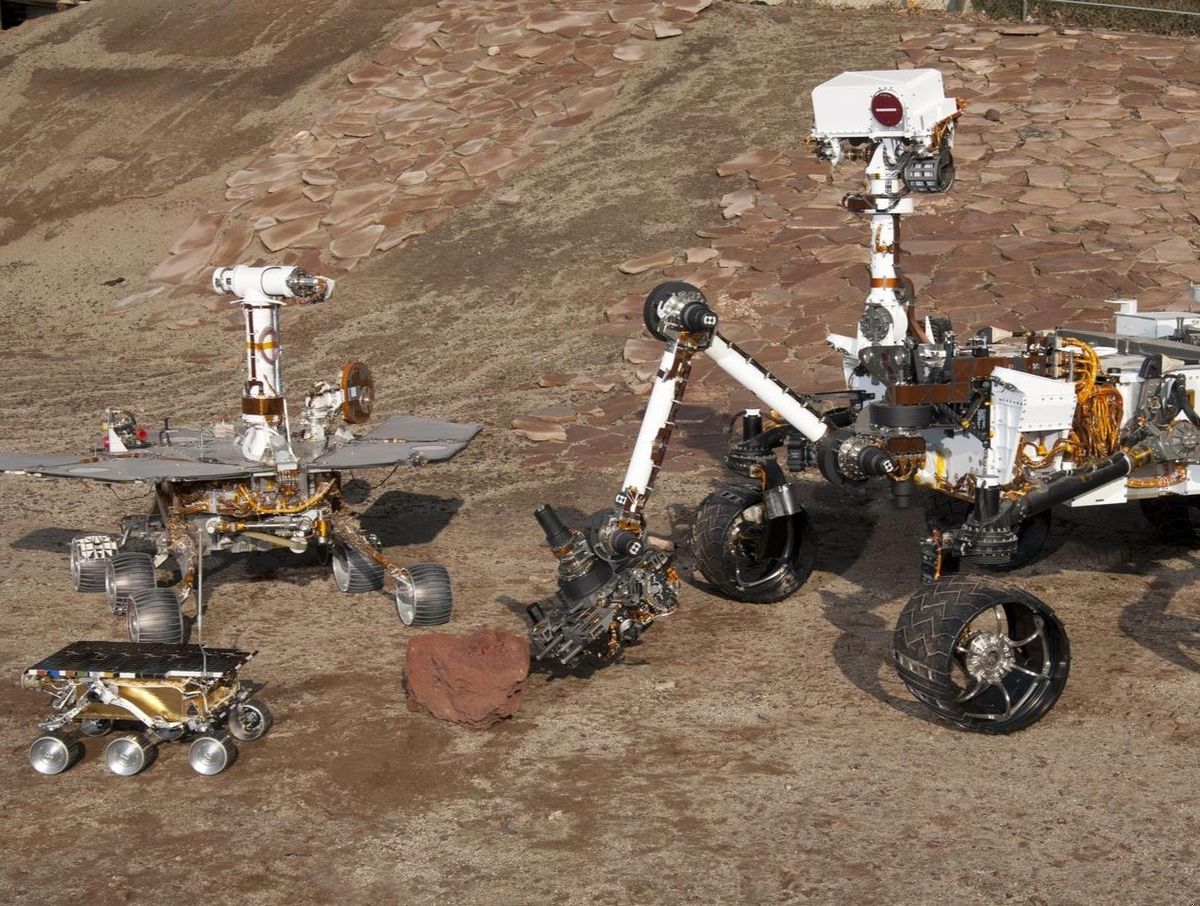
Sojourner Rover (opens in a new tab)
The first rover on Mars (1997), delivered by the Pathfinder lander. Now permanently parked.science.nasa.gov
Spirit & Opportunity (opens in a new tab)
Twin rovers that operated for years. Both are now inactive monuments to Mars exploration.science.nasa.gov
Viking 1 & 2 Landers (opens in a new tab)
The first U.S. landers to successfully operate on Mars (1976), remaining exactly where they touched down.science.nasa.gov
Phoenix & InSight Landers (opens in a new tab)
Phoenix dug for water ice; InSight listened for marsquakes. Both eventually lost power.science.nasa.gov
Dawn Spacecraft (opens in a new tab)
Mapped Vesta and Ceres. Ran out of fuel and remains in a perpetual, unpowered orbit around Ceres.science.nasa.gov
NEAR Shoemaker (opens in a new tab)
First spacecraft to orbit and land on an asteroid. Left resting on the surface of 433 Eros.science.nasa.gov
Pioneer 10 & 11 (opens in a new tab)
Early deep-space probes that explored the outer planets. Now drifting silently out of the solar system.science.nasa.gov
Ingenuity Helicopter (opens in a new tab)
The first aircraft on another planet. Sustained rotor damage and became a stationary artifact.science.nasa.gov
Kepler Space Telescope (opens in a new tab)
Revolutionary exoplanet-hunting telescope that ran out of fuel and is drifting in an Earth-trailing orbit.
From the NASA Space Apps Challenge. The official page is the final word on this challenge.
Built in Athlone
The 2 projects Athlone teams submitted for this challenge at HackAthlone 2026, from the teams’ own Space Apps pages. Links open in a new tab.
- 2026
- Best Local Application
Still Out There
by Alice In Astral-land
Abandoned but not Forgotten: Storytelling about NASA's Discarded Equipment on the Moon and Mars
We developed an audio and visual based storytelling app that explores the stories and journeys of 11 artefacts scattered across our universe. The journey is guided by Echo, a mysterious friend who mentions his personal investment he has in these stories. Echo moves backward in time starting from the crashed Perseverance descent stage to the historical pioneer rovers. Echo passes by 10 artefacts in his journey and has conversations with some of these abandoned artefacts or explain their significance as they are no longer able to share their stories themselves. Each of our artefacts have their own personalities, weaved by us around what they were, their purpose and how they got to where they are today. This project is important because it transforms cold, hardware technological history into an emotional, character driven narrative. By giving a voice our project has the potential to spark curiosity, builds empathy and interest people into exploring deeper into the universe fascinated by what was discovered in the past.
Read moreShow less
Team: Ritika Mahajan, Menomi Gamage
- 2026
Story of NaSAthlone
Abandoned but not Forgotten: Storytelling about NASA's Discarded Equipment on the Moon and Mars
Legacy Guardians: NASA Discarded Space Equipment Storytelling Challenge An interactive web-based educational adventure and visual novel developed for the NASA Space Apps Challenge. Set in the year 2150, players step into the boots of a Heritage Ranger guided by ARCHIE, an advanced archival AI. Together, they journey across the Solar System to rescue 9 historic, retired NASA space missions from impending destruction by commercial mining excavators, falling orbital debris, scrapper drones, and cosmic storms. 🚀 Key Features Tactical Solar System Map: An interactive canvas radar map spanning the inner planets, asteroid belt, and deep interstellar boundary. Visual Novel Presentation: Cinematic character standees (ARCHIE on the left, Ranger on the right) with active speaker highlighting, subtitle consoles, and live archival NASA telemetry displays. Authentic NASA Mission Challenges: 9 custom educational Codex challenges grounded 100% in official NASA science data and telemetry. Declassified Archival Gallery: Unlocking each beacon activates historical mission photos and detailed scientific debriefs.
Read moreShow less
Team: Tien Nam Tran