



Create Health Monitoring Software for Astronauts on Space Missions
Your challenge is to build a health monitoring software that gathers health indicators and enables astronauts to evaluate and act on the status of their health.
- Challenge video
- 5 resources
- CSA (Canadian Space Agency)1 partner agency
- 4 min read
Summary
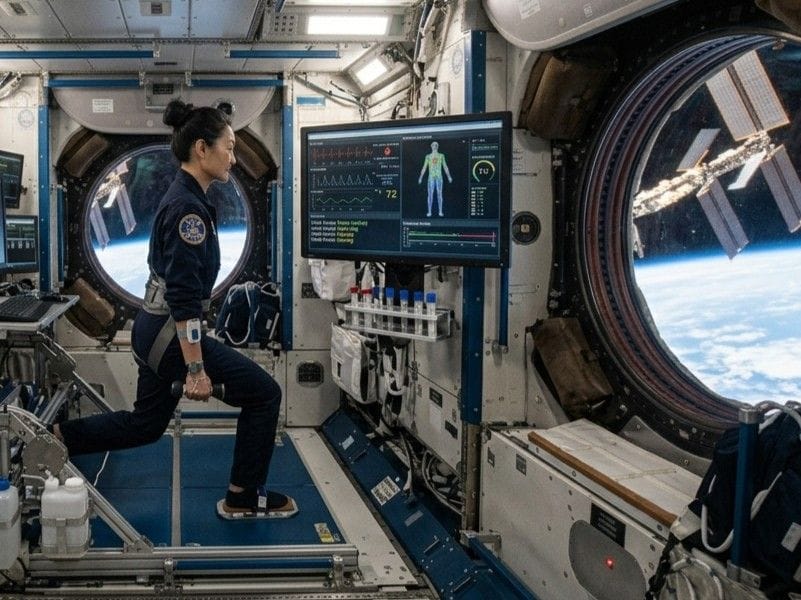
Long-duration missions expose astronauts to space radiation, isolation and confinement, altered gravity, and a hostile closed environment, which can bring immune changes, bone loss, cardiovascular events, and behavioral health problems. On long missions, astronauts carry much of the responsibility for spotting these changes in themselves. Your challenge is to build a health monitoring software that gathers health indicators and enables astronauts to evaluate and act on the status of their health.
Background
With rising investment in spacecraft technology and research, space missions have become more ambitious. NASA’s Artemis program recently accomplished a crewed lunar flyby, and NASA and others have plans to send humans to Mars in the future. With increasingly longer missions, astronauts will be more exposed to the hostile space environment, which brings both physical and mental health risks.
NASA’s Human Research Program has mapped the five hazards of human spaceflight, which are space radiation, isolation and confinement, distance from Earth, gravity fields, and hostile closed environments. These hazards can contribute to health problems such as immune system changes, bone density loss, cardiovascular events, inadequate nutrition, behavioral health conditions, and others. Astronauts must be capable of making health assessments on themselves during a mission, to prevent and treat health problems that may arise. Some useful health indicators are blood pressure, heart rate, blood sugar, body temperature, daily sleep hours, and mood.
Objectives
Your challenge is to create a visual tool that helps astronauts assess their own health during space missions and provides guidance on treatments and health improvements. You may consider gathering data from the user through any kind of input—keyboard text, mouse clicks, or camera images, for example. Any kind of data can be used, as long as it represents a health indicator, such as blood sugar levels in mg/dL or ultrasound images.
You can use NASA’s Human Research Program resources, along with the publicly available resources from other space agencies, to understand how spaceflight hazards affect human health, and to decide which indicators are useful and how they can support a quick assessment. Which measurements can be performed in space? Why is an exam needed? How do spaceflight hazards affect these health indicators? When might a result warrant attention from the crew or from flight surgeons on the ground? What actions can be taken to prevent a critical health condition? These are questions worth considering as you develop your solution.
User interface design plays an important role in presenting metrics and diagnosis clearly. You may consider taking advantage of animations and interactivity to present the information. For example, the software could display a human figure where each part of the body is clickable and displays information about its function and health status.
Potential considerations
You may (but are not required to) consider the following:
- Your tool could provide health insights for astronauts in different environments, such as a spacecraft, a space station, a rover, or a base on another planet or moon.
- Your tool could prompt astronauts to take measurements or complete specific actions from time to time as a part of the mission routine.
- Your tool could include the following features:
- A gamification system to help astronauts engage with tasks that support their health
- Dynamic charts that show how astronaut’s health indicators change over time
- Color coding that helps the astronaut interpret the status of a health indicator at a glance
- Do not assume that astronauts know everything about how to assess their health. Your tool could provide simple instructions and explanations covering measurements, health indicators, and risks.
NASA does not endorse any non-U.S. Government entity and is not responsible for information contained on non-U.S. Government websites. For non-U.S. Government websites, participants must comply with any data use parameters of that specific website.
NASA data and resources
nasa.gov
5 Hazards of Human Spaceflight (opens in a new tab)
Basic information from NASA’s human research program on the main hazards that affect humans on space missions. It also provides links to detailed NASA articles and reports related to a specific hazard.nasa.gov
Risks of Human Spaceflight (opens in a new tab)
Basic information from NASA’s human research program on the main risks faced by humans on space missions. It also provides links to detailed NASA articles and reports related to a specific risk.nasa.gov
Ongoing HRP Research in Space (opens in a new tab)
Articles from ongoing research on NASA’s human research program.
Space agency partner resources
CSA (Canadian Space Agency)
asc-csa.gc.caNon-NASA site
Monitoring Radiation for Astronaut Health (opens in a new tab)
Learn how the CSA is helping monitor space radiation to better protect astronaut health during long-duration missions. This resource highlights Canadian technologies and research used to measure radiation exposure in space and improve our understanding of its effects on the human body.asc-csa.gc.caNon-NASA site
Why Do We Conduct Science Experiments in Space? (opens in a new tab)
This CSA resource explains how the unique environment of space allows scientists to conduct experiments that cannot be performed on Earth. Learn how research aboard the International Space Station advances our understanding of human health, technology, and the universe. The discoveries made in space help improve life on Earth while supporting future exploration missions.
From the NASA Space Apps Challenge. The official page is the final word on this challenge.
Built in Athlone
The 9 projects Athlone teams submitted for this challenge at HackAthlone 2026, from the teams’ own Space Apps pages. Links open in a new tab.
- 2026
BioSphere Sync
Create Health Monitoring Software for Astronauts on Space Missions
CHECKPOINT is an offline-first prototype designed to support crew awareness during medical and operational incidents on long-duration space missions, where communication with Earth may be delayed. It brings simulated crew vitals, radiation exposure, cabin conditions, alerts, incident coordination, tasks, and message queues into one mission-control interface. A data-quality panel highlights missing or stale readings, while guest mode lets users explore fictional emergency scenarios without creating an account. By making uncertainty and communication delays visible, CHECKPOINT helps operators organize information and coordinate human review when timely support is limited. The project demonstrates how a crew could maintain a clearer picture of an evolving situation in isolation. It is a simulation, not a certified medical device, and is not intended for real patient or sensitive data.
Read moreShow less
Team: dhurgham alsaadi
- 2026
Sol Keepers
by Lame Timpala
Create Health Monitoring Software for Astronauts on Space Missions
Sol Keeper is a free browser game for ages 7 to 12 that trains the thinking behind a real Mars mission: keeping a crew alive. Players run a small outpost on the real ground of Jezero crater, built from the NASA HiRISE terrain map used to land Perseverance. Each sol they have only a few work slots to share between four supplies, oxygen, power, water and food, while daylight, dust storms and radiation change what every choice costs. They drive a rover across the crater, scan machines NASA left on Mars (Perseverance, Spirit, Opportunity and Sojourner) to learn their true stories, and 3D-print upgrades that fix the problems those missions faced. A message to Earth takes as long as it really would today, worked out from JPL orbital elements. The challenge asks for a trainer that makes mission trade-offs tangible and fun; Sol Keeper turns them into play. It runs in any web browser, including school Chromebooks, with no install and no login.
Read moreShow less
Team: Sai eeshwar D, Yuuv Jauhari, Tanmay Ghosh
- 2026
FARSIDE: Delay-Aware Crew Health Triage
by Last Commit
Create Health Monitoring Software for Astronauts on Space Missions
On the ISS, an astronaut who feels unwell can talk to a doctor within seconds. On Mars, a reply can take 44 minutes, and during solar conjunction it may not come at all. Today’s health tools can tell a crew that a reading looks wrong. They can’t tell them who should do something about it. We built FARSIDE to answer that. It reads the crew’s vital signs and cabin air, compares them with medical guidelines and with each person’s own normal, and then looks at how far away Earth is right now. If help from the ground is only minutes away, Earth makes the call. If it isn’t, the crew medic gets clear instructions straight away. A report still goes back to Earth, with a countdown showing when the reply should arrive. The readings don’t change. Only the distance does, and so does the decision.
Read moreShow less
Team: Shreya Setty, DAKSH SINGLA, Nandini Lashkari, Ansh Rajendrakumar Desai, Om Rahul Juvekar, Diksha Chottani
- 2026
Astronaut Health Monitor — Autonomous HRV Stress Detection for Deep-Space Missions
by Machine Lovers
Create Health Monitoring Software for Astronauts on Space Missions
Long-duration deep-space missions expose astronauts to communication delays of 20+ minutes each way, making real-time consultation with flight surgeons impossible. Drawing on NASA's Human Research Program framework of spaceflight hazards, we built an offline-first health monitoring dashboard that detects autonomic stress from heart rate variability (HRV) data — before symptoms appear. Astronauts upload a standard RR-interval CSV exported from any HRV-capable wearable. The system extracts time-domain and frequency-domain HRV features (mean HR, RMSSD, SDNN, LF/HF ratio), runs a lightweight RandomForest classifier trained on the WESAD stress dataset, and displays a color-coded triage report with plain-language recovery guidance. The entire inference pipeline runs CPU-only with no network connection, on hardware as lightweight as a Raspberry Pi 5 (model: 666 KB, inference: 11ms/window, peak RAM: 237 KB), making it deployable as an isolated spacecraft medical workstation.
Read moreShow less
Team: Ettore Caprioli
- 2026
NASAthon - Athena
by NASAthon
Create Health Monitoring Software for Astronauts on Space Missions
We developed a health monitoring system for astronauts in space during missions. This system tracks the live vitals of astronauts, creates their health baseline and gives them a score. This score updates based on changes with a crew members breathing, blood pressure and other important readings. This gives astronauts quick and relevant information on what is happening to their bodies and can find trends to predict when a potential risk could occur. If there was a mission on Mars, it could take up to 40 minutes to receive information from doctors on Earth. Our software being offline based contains the relevant information so that astronauts aren't relying on a response from Earth when they need to treat themselves.
Read moreShow less
Team: Isaac Adeniji, Mercy Olasehinde, Chidozie Onyejelem, Izabela Heczkova
- 2026
Orbit Baseline
Create Health Monitoring Software for Astronauts on Space Missions
Orbit Baseline is an interactive prototype of a personal self-care and early intervention support tool for astronauts on long missions. It is trainable by the astronaunt and ground team over time, and It gathers health indicators with wearable technology and self-reporting (sleep, heart rate variability, skin conductance, breathing, temperature, blood pressure, blood sugar, hydration, and mood) and compares each against the astronaut’s own baseline, learned on Earth and adapted for space, rather than a generic range; it orbits personal baselines. It also uses a psychological 360 view that weighs how the person says they feel, treating a gap between the data and the person’s report as useful information, while being observed by experts back at base. When early drift (from individual baseline norm) appears, the app offers personalised, doable actions, from breathing and body-based practices to rest, play, or an immersive sensory space with VR, and learns from 'Was this helpful?' feedback. A blended-care model keeps flight surgeons and psychotherapists in the loop, with the astronaut choosing what to share, which suits deep-space communication delays. Supported with a COM-B design for digital mental health. It matters because on missions far from Earth, astronauts must notice problems in themselves early and act. Orbit Baseline supports care before crisis. The prototype uses simulated data. In operation, it draws data from wearable technology and user self-reporting.
Read moreShow less
Team: Jenny Fennessy
- 2026
S.G.U.F.: A Gamified Health Monitoring System for Astronauts
by Sol Searchers
Create Health Monitoring Software for Astronauts on Space Missions
S.G.U.F. is a wearable health-monitoring system that lets astronauts check their own health without medical training, while keeping Earth's flight surgeons informed. Our Arduino prototype reads pulse and movement, logs astronauts in with an RFID tag, and shows a green, amber or red traffic light plus a plain-language LCD message. A Raspberry Pi hub compares every reading with the astronaut's own baseline, and a crew app collects activity, posture and mood check-ins. Alerts are reassuring, jargon-free and automatically sent to Mission Control. A planned microneedle patch would track blood counts; blood and pressure data are simulated and clearly labelled. It addresses the challenge by reducing human error and mental load, flagging early changes linked to NASA's five spaceflight hazards, and telling crew when to contact a flight surgeon. Points for completing check-ups, never for health values, and mission leaderboards make routine monitoring engaging and support crew wellbeing.
Read moreShow less
Team: Conor McEvoy, Amelia Isabella Reinhardt, zack dolan, Jack Brady
- 2026
Aegis: Autonomous Emergency Guidance In Space
by Space_Docs
Create Health Monitoring Software for Astronauts on Space Missions
Aegis is an offline-first emergency console for astronauts on deep-space missions, built for a tablet. On a Mars transit, a message to the flight surgeon takes around 12-24 minutes each way, so the crew has to act first. A crewmate taps what they see, such as bleeding, chest pain or a burn. Live wearable vitals fill in the rest, and the app ranks the matching procedures from NASA’s own Medical Checklist and opens them with the original pages unmodified. Medications that need surgeon approval are highlighted, with “Contact Surgeon” first. Aegis never diagnoses and never writes drug names or doses. The checklist stays the authority, and the app only finds the right page quickly. The page needs no network at run time. Wearable data is simulated, and the project is a demo, not a medical device.
Read moreShow less
Team: Anish Sudhakar Gore, Victor Andrade Resende, Sruthi Thumu, Martin Mcsweeney
- 2026
DAILY HEALTH CHECK-IN SYSTEM IN ZERO GRAVITY
by Wheel of Carcosa
Create Health Monitoring Software for Astronauts on Space Missions
The Goal of this program is for astronauts to use this program daily to monitor their physical health, find red flags in their routine, and then act accordingly, either by making chances themselves or talking to a medical officer. The program begins by asking the user for basic information. Once these questions are filled, a menu will drop down asking the user to select from the following options: Vision Questionnaire, Red Blood Cell Amount, Bone Density, Blood Lab, Muscle Atrophy test, and Radiation Exposure. Each option chosen has a different list of questions to be answered, in which the user (in some, not ALL) may need the results of tests outside of program to enter in. Once these values are entered, they will be compared to the expected average person, if the entered values fall outside this range, the program will print that it sees this issue, otherwise anything within the expected ranges will not cause any red flags. The user is now expected to use the program in order to alert a medical officer of their results, and from there the trained professional will decide the best course of action.
Read moreShow less
Team: Jessica Wade, Elisabeth DeMarco, Josh Scully, Sionnach Brophy