Flame in Freefall: SI-Powered Fire Safety Insights from Microgravity Combustion Data
Your challenge is to create an interactive, super intelligence (SI) powered dashboard that summarizes, ranks, and interprets those findings to deliver fire safety insights for human space exploration.
- Challenge video
- 10 resources
- 7 min read
Summary
For decades, NASA has studied how flames and fire behave in microgravity, gathering a trove of experimental data along the way. That knowledge matters more than ever as humans gear up to return to the Moon and press on to Mars, yet the volume of results makes them hard to find, compare, and understand. Your challenge is to create an interactive, super intelligence (SI) powered dashboard that summarizes, ranks, and interprets those findings to deliver fire safety insights for human space exploration.
Background
Fire hazards are extremely dangerous in space exploration! In describing a smoke alarm that went off during the recent Artemis II mission, the commander commented, “[If] you want to get somebody’s attention really quick, make the fire alarm go off in your spacecraft when you’re still about 80,000 miles from home.” Decades earlier, the Apollo 13 crew endured the life-threatening results of an oxygen tank explosion on their way to the Moon. Similarly, a multinational crew survived a fire aboard the Mir space station caused by an oxygen generator failure. In 1967, the Apollo 1 crew died in a pre-launch test when fire erupted in their oxygen-filled spacecraft.
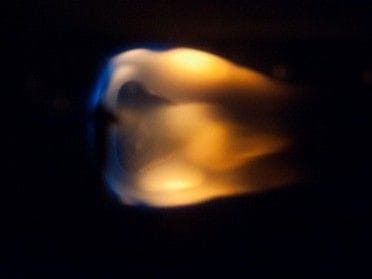
Compared to Earth, flames in free fall (i.e., in microgravity) are often dramatically different because of the absence of buoyancy and thus rising hot gases. Instead of a flickering teardrop, a candle flame becomes a ghostly blue sphere reliant on diffusion for its oxygen.
NASA’s spacecraft fire safety work is focused on prevention, detection, and suppression. Prevention is achieved by controlling ignition sources and through material selection, which depends on understanding flammability limits. To facilitate spacesuit use, an atmosphere with increased oxygen and reduced pressure compared to Earth’s is expected within the planned Moon Base and pressurized rovers. Flammability is highly dependent on oxygen concentration, and air flow is also important in microgravity. Flammability studies focus on solid materials such as fabrics and plastics, as studied in the Burning and Suppression of Solids (BASS and BASS-II) and Spacecraft Fire Safety Demonstration (Saffire-I, -II, and -III) investigations.
Fire detection was tested in microgravity through the Smoke and Aerosol Measurement Experiment studies (SAME and SAME-R). Suppression was studied in the Flame Extinguishment Experiment (FLEX) through dilution of the chamber atmosphere with carbon dioxide and helium, both of which suppress fire.
Objectives
Results from low-gravity combustion experiments, conducted for example on the International Space Station (ISS), are being made publicly available through NASA's Physical Science Informatics (PSI) database, but the amount of data can be overwhelming. It can be hard to find, harder to compare, and harder yet to interpret.
Your challenge is to build an SI-powered, web-based dashboard that summarizes, ranks, and interprets combustion science investigations to deliver critical foundational insights for fire safety. You may consider enabling users to:
- Identify investigations most relevant to the fire safety needs of habitable crew environments, including spacecraft, space stations, bases on the lunar and Martian surfaces, and pressurized rovers.*
- Extract data that supports predictive modeling of flammability and fire scenarios in space exploration.
- Highlight research that informs the development of next-generation fire safety controls and equipment.
In this challenge, you’ll help turn complex data into clear answers and make the next giant leap a safer one.
Your dashboard could also address potential applications of the PSI data to fire safety on Earth. Fine-water-mist extinguishers developed for use on the ISS have practical applications here on Earth, and NASA technology has similarly led to improvements in terrestrial smoke detection and firefighter gear, including protective clothing and air tanks.
*Fire safety involving rockets and propellants is generally beyond the scope of the research available in the PSI database. The high velocities within rocket engines render the combustion effectively independent of gravity — although a rocket’s launch is of course strongly dependent on gravity.
Potential considerations
You may (but are not required to) consider the following:
- Your target audience can include professors, graduate students, undergraduate students, aerospace researchers, and aerospace engineers.
- Consider how you might summarize and display attributes such as:
- Experimental objectives
- Fuels, including shape and size of the samples or burners
- Other test conditions, such as oxygen concentration and airflow speed
- Variables: how did tests from the same investigation differ and how were they the same?
- Sensors or types of measurements
- Consider how to summarize and display similarities and differences between different investigations.
- Other investigations in PSI
- One of the instruments used for smoke detection in the SAME and SAME-R studies was instead used to detect dust in the Dust and Aerosol Measurement Feasibility Test (DAFT and DAFT-2) studies.
- While it burned gaseous fuels, the Burning Rate Emulator (BRE) experiment of the Advanced Combustion via Microgravity Experiments (ACME) project was a study of materials flammability in still atmospheres as a function of material properties.
- Other combustion investigations within the PSI database (but not explicitly referenced above) are still relevant to fire safety, just not as strongly or directly.
- Hardware
- The six experiments in the ACME project featured flames of gaseous fuels and were all conducted with the same modular set of ACME hardware in the Combustion Integrated Rack (CIR).
- FLEX, FLEX-2, and the Cool Flames Investigation (CFI) each featured burning droplets of liquid fuel and were conducted with the Multi-user Droplet Combustion Apparatus (MDCA) in the CIR.
- BASS, BASS-II, the Smoke Point In Co-flow Experiment (SPICE), and the Structure & Liftoff In Combustion Experiment (SLICE) collectively featured both solid and gaseous fuels. Each of these investigations was conducted within the Microgravity Science Glovebox (MSG) using the modular fan-driven flow duct built for SPICE.
- Spacesuits and oxygen concentration
- To enable flexibility, spacesuits are filled with 100% oxygen to only 4.3 psi (pounds per square inch), where the Earth’s pressure at sea level is 14.7 psi.
- To avoid the bends (decompression sickness), the astronauts pre-breathe 100% oxygen to expel absorbed nitrogen.
- To reduce the pre-breathing duration and thus facilitate lunar excursions, it is expected that the Moon Base and pressurized rover(s) will be at a pressure and oxygen concentration between those in a spacesuit and the Earth’s atmosphere.
- The intermediate oxygen concentration used on the Moon will likely be 30% or greater, with a corresponding pressure of 10.2 psi or less. Compared to Earth’s atmosphere, that’s more than a 40% increase in the oxygen concentration making materials much more flammable.
- Microgravity tests with the highest oxygen concentrations were conducted as part of the ACME’s Cool Flames Investigation with Gases (CFI-G). In those tests, the combustion chamber was filled with a mixture of nitrogen and a flammable gas (e.g., propane), while an oxygen-nitrogen mixture of up to 85% oxygen flowed from the spherical burner creating an inside-out flame.
- Partial-gravity data
- Although NASA is heavily focused on the return of astronauts to the Moon’s surface and the establishment of a Moon Base in preparation for the future human exploration of Mars, there is currently no partial-gravity combustion data available in PSI. We expect such data will be added in the future, for example from the Lunar-g Combustion Investigation (LUCI) and the Flammability of Materials on the Moon (FM2) experiment.
- Partial gravity was mimicked in ACME’s Electric-Field Effects on Laminar Diffusion Flames (E-FIELD Flames) experiment through the effect of the electric field on the ions that naturally occur in flames.
- Microgravity and normal-gravity results could bound what occurs at intermediate gravity levels.
NASA does not endorse any non-U.S. Government entity and is not responsible for information contained on non-U.S. Government websites. For non-U.S. Government websites, participants must comply with any data use parameters of that specific website.
NASA data and resources
psi.nasa.gov
PSI Data Repository: Combustion Science (opens in a new tab)
Physical Sciences Informatics (PSI) source of the data upon which the NASA Space App is to be based.nasa.gov
NASA Combustion Science (opens in a new tab)
Basic information about most of the combustion investigations for which data is found in the PSI Data Repository.youtube.comNon-NASA site
NASA ScienceCasts: The Power of Studying Combustion on the ISS (opens in a new tab)
Introduction to NASA’s combustion research on the International Space Station through a 3.6-minute video clip from 2018.nasa.gov
A Researcher’s Guide to International Space Station Combustion Science (opens in a new tab)
A 2015 review of NASA’s combustion research conducted on, or planned for, the International Space Station. Basic information about most of the combustion investigations described in this 50+ page document is found within the PSI Data Repository.sma.nasa.gov
Apollo 1 (opens in a new tab)
Information about the crew mission, fire that erupted during a pre-launch test killing the crew, investigation, and lessons learned.sma.nasa.gov
Apollo 13 (opens in a new tab)
Information about the crew, mission, oxygen tank explosion that occurred during the flight to the Moon, investigation, and lessons learned.nasa.gov
25 Years Ago: Fire Aboard Space Station Mir (opens in a new tab)
Basic information about a fire—caused by an oxygen generator failure—that erupted within the Russian space station Mir in 1997 during joint operations in preparation for the International Space Station (first occupied in 2000).spinoff.nasa.gov
Fireman’s Air Tanks (opens in a new tab)
Basic information about the 1970s adaptation of spacesuit technology to improve firefighters’ air tanks and breathing gear.spinoff.nasa.gov
Fire Detector (opens in a new tab)
Basic information about a 1970s smoke detector developed for the shuttle that, discriminating between smoke and dust, results in less nuisance alarms. As such, it has industrial applications (e.g., in mining operations).spinoff.nasa.gov
New Technology for the Fire Attire (opens in a new tab)
Basic information about a 1980s application of NASA spacesuit technology to improve firefighter clothing.
From the NASA Space Apps Challenge. The official page is the final word on this challenge.
Built in Athlone
The project Athlone teams submitted for this challenge at HackAthlone 2026, from the teams’ own Space Apps pages. Links open in a new tab.
- 2026
StarFire
Flame in Freefall: SI-Powered Fire Safety Insights from Microgravity Combustion Data
Do you know the exact flammability risk of materials used across space stations? If not, don't worry, navigating NASA’s Physical Sciences Informatics (PSI) repository with over 100 microgravity combustion investigations can be overwhelming, unless you already know exactly where to look. That's why I built StarFire, an interactive assistant that turns raw curiosity into structured research discovery. Rather than presenting another passive catalog, it invites users to ask their own questions in plain English, whether about material flammability, flame spread, smoke detection, or fire suppression, and instantly serves up a ranked shortlist of relevant investigations. Each result comes with a tailored, AI-generated research note explaining its direct connection to your question, highlighting useful metadata evidence, offering a cautious interpretation and suggesting a concrete next research step. Users can inspect the raw metadata, follow original NASA source links, compare investigations side-by-side and download a research brief. All you need to bring is curiosity and an initial query and StarFire kickstarts your research journey! Ultimately, finding relevant research does not mean a dataset is immediately ready for modeling or that a safety conclusion is proven. StarFire keeps source evidence transparent and separate from AI interpretations, giving researchers a reliable launchpad without replacing scientific judgment. Happy researching 🚀!
Read moreShow less
Team: Soukaina Rhazzafe